Expert Stove & Oven Repair in Needham, MA
Appliance Repair for Homes & Businesses in Needham, Dover, Needham Heights, Massachusetts and Nearby Areas
Stove and Oven Repair in Needham, Massachusetts, Appliance Repair Pros
Stove and Oven Repair in Needham, Massachusetts, ensures that your family dinner plans are not derailed by a cold oven or a clicking burner. At Appliance Repair Pros, we provide expert diagnostics and repair services for homeowners in Needham, Needham Heights, and Dover who rely on home cooked meals. When your range refuses to heat, bakes unevenly, smells like gas, or displays an error code, it creates an immediate safety concern and disruption. Whether you are cooking on a vintage gas stove in a historic Dover home or using a high-tech induction cooktop in a Needham Heights condo, we understand the specific electrical and gas configurations found in our local area. Our technicians approach every job with a focus on safety and precision, ensuring that gas lines are secure and temperatures are calibrated correctly. We treat your kitchen with the utmost respect, keeping our work area clean and arriving within a dependable time window. If you are tired of ordering takeout because your stove is down, let us help you get back to cooking. Contact us today.
Stove and Oven Repair Services in Needham
We provide comprehensive repair services for all major cooking appliances. Modern cooking equipment ranges from simple coil-top electric stoves to complex dual-fuel ranges with steam injection. We understand the thermodynamic principles and safety protocols required to work on these powerful appliances.
Cooking systems we work on
- Gas and electric freestanding ranges
- Built-in wall ovens (single and double)
- Gas cooktops and rangetops
- Electric glass-top and coil stoves
- Induction cooktops
- Dual-fuel ranges (gas cooktop with electric oven)
- Slide-in and drop-in units
What makes oven and stove repair tricky
- High-voltage electrical circuits (240V)
- Combustible gas lines and safety valves
- Sensitive temperature resistance sensors
- Electronic control boards and touch panels
- Hidden spark modules and ignition switches
- Convection fans and baffle systems
- Motorized door latches for self-cleaning
- Ceramic glass surfaces that require special handling
Common Oven and Stove Problems We Fix
Oven is not heating up
This is the most common issue we encounter. You turn the oven on, the light comes on, but the inside stays cold. This usually points to a failure in the ignition or heating system, meaning the oven cannot generate heat regardless of the setting.
- Weak or broken gas igniter (glow bar)
- Burned out bake or broil heating element
- Tripped thermal fuse
- Failed safety valve
- Broken wire or connection
How we diagnose it
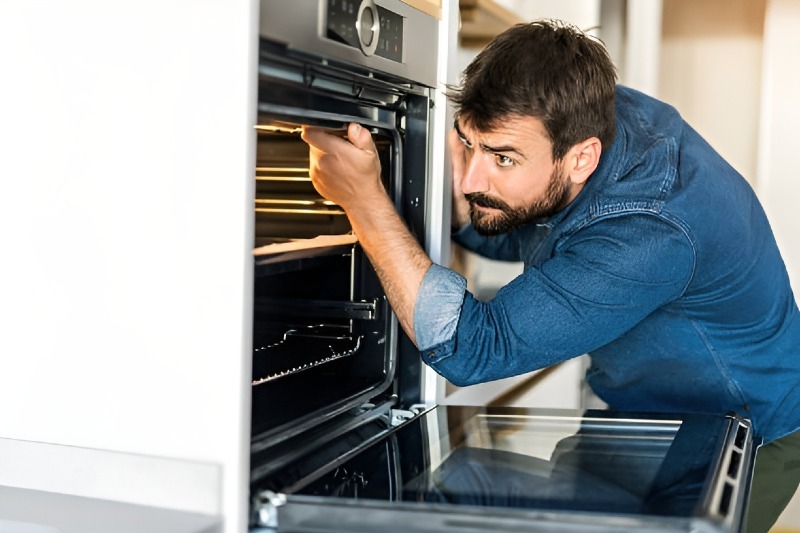
For gas ovens, we observe the igniter to see if it glows white-hot or just orange. For electric ovens, we test the element for continuity and check voltage at the control board to ensure power is being sent to the heater.
What you can do right now
Check if the clock is set correctly, as some ovens will not heat if the automatic timer is engaged. Reset your home circuit breaker to ensure the unit is receiving full power.
Gas burner clicks but will not light
The continuous clicking sound of a gas stove trying to light is annoying, but the smell of unburned gas that follows is dangerous. This often happens when the spark is present but not strong enough or not in the right spot to ignite the fuel.
- Clogged burner ports blocking gas flow
- Misaligned burner cap
- Cracked or wet spark electrode
- Faulty spark module
- Defective ignition switch harness
How we diagnose it
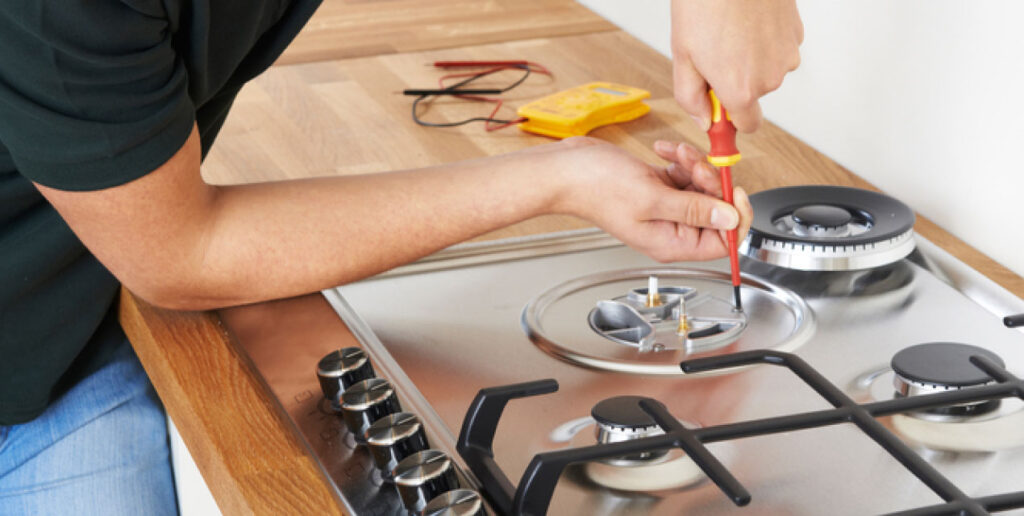
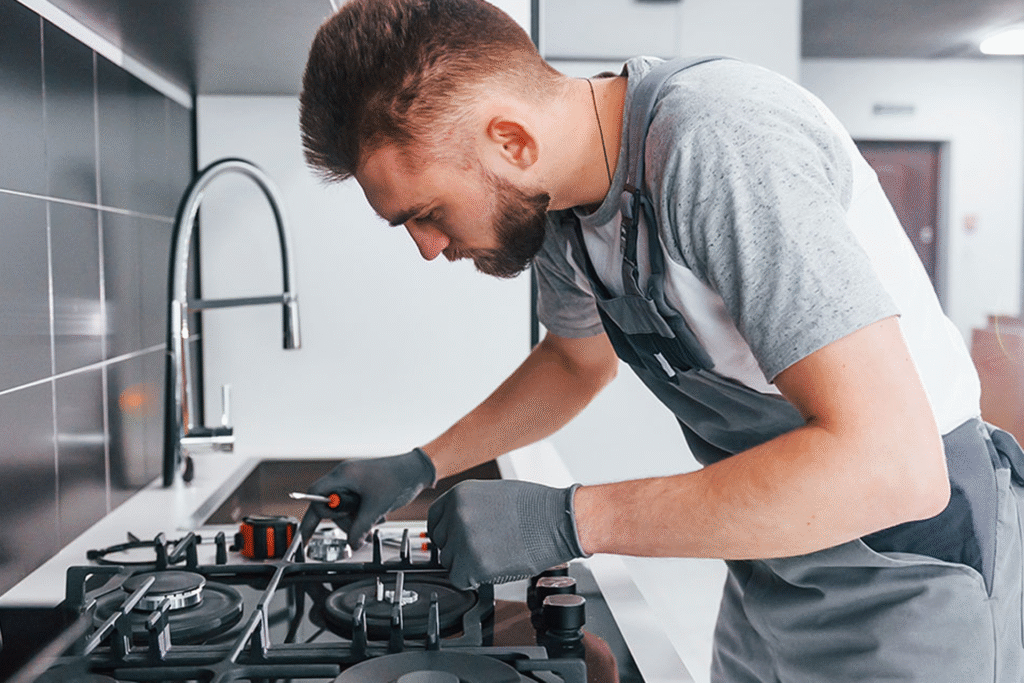
We remove the burner cap and grate to inspect the electrode for cracks or food debris. We test the spark module to see if it is sending high voltage to the correct burner.
What you can do right now
Clean the burner head thoroughly with a stiff brush to remove grease or spillover. Ensure the burner cap is sitting perfectly flat and centered.
Oven bakes unevenly or burns food
If your cookies are burning on one side or your roasts are raw in the middle, your oven is likely suffering from airflow issues or temperature drift. This is common in older appliances where sensors lose accuracy over time.
- Failed convection fan motor
- Temperature sensor (thermostat) out of calibration
- Blocked airflow vents
- Bottom heating element not working (using broil only)
- Warped door hinges letting heat escape
How we diagnose it
We measure the internal temperature with a digital thermometer to compare it against the set temperature. We also test the resistance of the temperature sensor and check the fan operation.
What you can do right now
Make sure you are not overcrowding the racks with large pans that block heat circulation. Check the door gasket for visible tears.
Electric cooktop element not working
On a glass-top stove, you might turn a knob and see no red glow. This can be caused by the element itself burning out or the switch that controls it failing.
- Burned out ribbon element under the glass
- Faulty infinite switch (knob control)
- Loose wire connection
- Broken surface element limiter
How we diagnose it
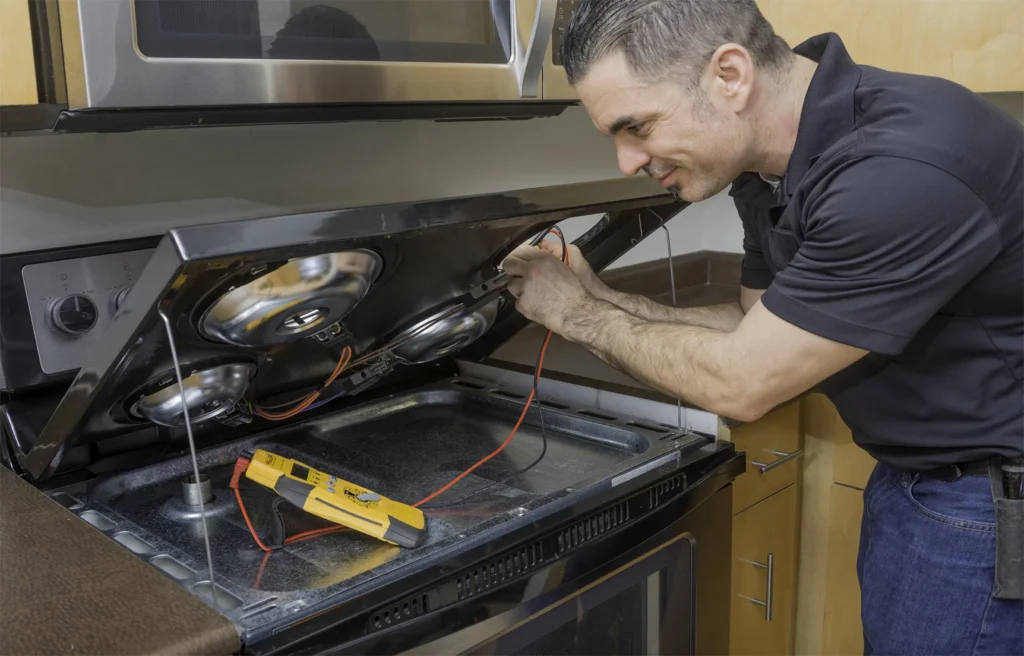
We lift the cooktop to test the continuity of the heating element coils. We also test the switch contacts to ensure they are closing properly when the knob is turned.
What you can do right now
Try using a different burner to confirm if the issue is isolated to one spot or if the whole cooktop is dead.
Oven door is stuck locked
This often happens after a self-cleaning cycle. The high heat engages a safety latch, and if the motor or sensor fails, the door remains locked even after the oven has cooled down, trapping your food or preventing use.
- Defective door lock motor assembly
- Bad door switch sensor
- Control board relay failure
- Warped door frame from high heat
How we diagnose it
We access the lock assembly, usually from the back or top, to manually release the latch. We then test the motor and switches to determine why it failed to disengage.
What you can do right now
Do not force the door open, as this will break the latch and the glass. Allow the oven to cool completely for at least an hour before trying to open it again.
Faint smell of gas while cooking
While a strong rotten egg smell requires immediate evacuation, a faint whiff of gas only when the oven is on can indicate a different type of failure within the ignition process.
- Delayed ignition (gas builds up before lighting)
- Weak igniter taking too long to open the valve
- Minor leak at the regulator or internal piping
How we diagnose it
We use an electronic combustible gas detector to sniff all internal connections. We verify the “time to light” sequence to ensure the burner ignites within a safe window.
What you can do right now
Turn off the appliance immediately. Ventilate the area. If the smell persists even when the unit is off, shut off the main gas supply and call a professional.
Control panel is unresponsive or displaying code
Modern ranges are controlled by computers. Power surges or moisture from steam can damage the touch pad or the main control board, rendering the appliance useless.
- Stuck or shorted key on the membrane pad
- Main control board failure
- Loose ribbon cable connection
- “Child Lock” feature accidentally enabled
How we diagnose it
We test the ribbon cable for continuity to see if the buttons are registering. If the buttons work but the oven doesn’t respond, the main board is usually the culprit.
What you can do right now
Check if the “Lock” or “Control Lock” light is on. Hold the lock button for 3 seconds to try and disengage it. Try flipping the breaker off for 5 minutes to reset the electronics.
Glass cooktop is cracked
A heavy pot dropped on a ceramic cooktop can cause a crack. Once cracked, the unit is unsafe to use because liquids can seep into the high-voltage electrical components below.
- Physical impact from heavy object
- Thermal shock from cold water on hot glass
- Overtightened installation screws
How we diagnose it
This is a visual diagnosis. Unfortunately, glass tops cannot be repaired; the entire glass assembly must be replaced to restore safety.
What you can do right now
Stop using the cooktop immediately. Do not tape over the crack. Using a cracked cooktop is a significant electrical shock hazard.
Safety Notes for Stove and Oven Issues
Cooking appliances involve inherent risks because they generate high heat and often use combustible fuels. Ignoring warning signs can lead to fire, carbon monoxide poisoning, or electrical shock. We prioritize safety above all else when working in your home.
Important safety checks:
- If you smell a strong rotten egg odor, leave the house immediately and call your gas utility provider from a safe distance. Do not operate light switches or phones inside.
- If you see yellow or orange flames instead of blue on a gas burner, this indicates incomplete combustion and potential carbon monoxide production. Stop using the burner until it is serviced.
- If you see sparking or arcing from a control knob or the back of the stove, turn off the circuit breaker immediately.
- If the glass door shatters, carefully sweep up the debris but do not use the oven until the door is replaced, as heat will escape and damage the knobs and control panel.
Brands We Service for Stove and Oven Repair in Needham
From the sturdy commercial-style ranges in Dover estates to the sleek slide-in units in Needham Heights condos, we service a broad spectrum of cooking appliance brands. Each manufacturer has unique ignition systems and sensor values that require specific technical data.
Whirlpool family (Whirlpool, Maytag, KitchenAid, Amana)
These are the workhorses of many local kitchens. They are generally reliable, but the direct spark ignition systems on their gas cooktops and the control boards on their ovens are common failure points.
- Common issues we see: Weak oven igniters causing slow heating, “F1” errors on the control board, and broken door hinges.
Diagnosing these units accurately is key because a slow-heating oven is often mistaken for a thermostat issue when it is actually a weak igniter that isn’t pulling enough amperage to open the gas valve.
GE family (GE, Hotpoint, Café, Profile)
GE ranges are known for their versatile cooktops and accurate ovens. They use a specific type of sensor technology and often feature double-oven configurations that require specialized disassembly to access components.
- Common issues we see: Failed meat probe jacks, calibration issues requiring offset adjustments, and surface element switches burning out.
We are familiar with the “OFFSET” calibration features in GE ovens, which allows us to fine-tune the temperature without replacing parts if the sensor has drifted slightly.
Samsung and LG
These brands feature heavy electronics and rapid-boil burners. They offer great features but are sensitive to power fluctuations and airflow restrictions. Their convection systems use specific fans that must run at exact speeds.
- Common issues we see: Relay board failures, convection fans making loud noises, and burners cycling on and off too quickly.
Diagnosis often involves interpreting complex error codes that point to specific sub-systems like the cooling fan or the touch control interface.
Bosch and Thermador
Found in many high-end Needham kitchens, these units are engineered for precision. Thermador gas ranges often use a “star” burner pattern and a clicking solenoid system that is different from standard ranges.
- Common issues we see: Solenoids sticking (causing constant clicking), low flame issues, and error codes related to the cooling fan speed.
Servicing these requires a delicate touch, particularly with the stainless steel finishes and the complex wiring harnesses used in their pro-style ranges.
Wolf and Viking (Premium Brands)
For the professional-grade kitchens in Dover and Wellesley, we handle these heavy-duty units. They rely less on computer boards and more on robust mechanical thermostats and valves, but access can be difficult due to their weight and build.
- Common issues we see: Door hinge seizures, spark module failures, and grease clogging the ignition ports.
Repairing these units ensures you maintain the high performance and value of your luxury kitchen investment.
Understanding Common Oven Error Codes
When your oven detects a problem, it often shuts down and displays a code to prevent unsafe operation. These codes give us a head start on diagnosis.
- F0 / F1: Electronic control board failure or stuck key. The computer is confused or a button is permanently pressed.
- F2: Over-temperature. The oven got too hot, likely due to a stuck relay or bad sensor.
- F3 / F4: Temperature sensor circuit open or shorted. The oven cannot read the internal temperature.
- F5: Door latch and lock assembly failure. The door switches aren’t telling the board the correct position.
- F7: Keypad matrix failure. Usually means the touch panel ribbon cable is loose or damaged.
- F9: Door lock safety circuit issue. Common after a self-clean cycle.
Maintenance Tips for Stove and Oven Owners in Needham
Preventative care can keep your range looking new and cooking safely. In older Needham homes with potentially less stable voltage or older gas lines, keeping an eye on your appliance is extra important.
- Clean spills immediately: Sugary or acidic spills (like tomato sauce) can pit the enamel on the oven floor or damage the glass cooktop surface if left to bake on.
- Check the door seal: Periodically feel the rubber gasket around the oven door. If it is torn or brittle, heat escapes, causing uneven baking and damage to the knobs above the door.
- Don’t block the vents: Gas ovens need airflow to burn correctly. Never line the bottom of the oven with foil, as it blocks air slots and can cause carbon monoxide buildup.
- Clean burner ports: Use a paper clip or a needle to gently clear the small holes in gas burner heads. This ensures a clean, blue flame and reliable ignition.
- Use self-clean sparingly: The extreme heat of the self-clean cycle is the number one cause of component failure (fuses, boards, latches). We recommend manual cleaning for longevity.
- Protect glass tops: Ensure the bottom of your cookware is flat and smooth. Cast iron can scratch glass cooktops easily.
- Verify the anti-tip bracket: If you pull the stove out to clean, make sure the rear leg re-engages with the anti-tip bracket on the floor or wall when you push it back.
- Calibrate once a year: Buy a cheap oven thermometer to check your oven’s accuracy. If it’s off by more than 25 degrees, it may need recalibration.
Service Area for Stove and Oven Repair in and Around Needham, Massachusetts
Our service area is focused on the local communities of Norfolk County. We regularly service homes in the leafy neighborhoods of Needham, the bustling commercial and residential mix of Needham Heights, and the expansive properties in Dover. Whether you are located near the Charles River Peninsula or closer to the Wellesley line, our technicians are nearby and ready to help.
- Needham
- Needham Heights
- Dover
- Birds Hill
- Needham Junction
- Greendale
- Wellesley
- Westwood
Zip codes we serve: 02492, 02494, 02030
Frequently Asked Questions
Why does my gas oven take so long to heat up?
A gas oven should reach 350°F in about 10 to 15 minutes. If it takes longer, the most likely cause is a weak igniter. The igniter must draw a specific amount of electrical current to open the gas safety valve. As they age, they get weaker and take longer to open the valve, resulting in slow heating or an oven that won’t light at all.
Can you replace just the glass on my cooktop?
Yes, the glass ceramic surface can be replaced, but it comes as a large assembly. It is a specialized repair that requires disassembling the entire top of the range. While not the cheapest part, replacing the glass is much safer than using a cracked unit and is often more economical than buying a brand new range.
Is it better to repair a vintage stove or replace it?
In many of Dover and Needham’s historic homes, we see vintage ranges that are built like tanks. These units often have simple mechanical parts that are very durable. Unless the parts are completely obsolete, we often recommend repairing vintage stoves as they have a build quality that is hard to find in modern appliances.
What causes the “F1” error code on my range?
The F1 code is one of the most common errors and usually indicates a problem with the electronic control board or the touch pad. It often means a key is stuck or the board has shorted out. If you see this, try unplugging the stove for 5 minutes. If the code returns, the electronic component likely needs replacement.
Why is my convection fan making a loud noise?
A noisy convection fan usually indicates that the motor bearing is worn out or the fan blade has become loose and is hitting the housing. Over time, grease can build up on the fan blades, causing them to become unbalanced. We can inspect the fan assembly and tighten or replace it to restore quiet operation.
Do you work on dual-fuel ranges?
Yes, we are experienced with dual-fuel ranges, which combine a gas cooktop with an electric oven. These units require a technician who is skilled in both gas plumbing and high-voltage electrical diagnostics. We understand the unique requirements of these hybrid appliances.
Why is my burner sparking even after the flame is lit?
This is usually caused by a dirty flame sensor or moisture in the burner assembly. The system thinks the flame has gone out and is trying to re-ignite it. Cleaning the burner cap and allowing the unit to dry out often fixes it. If not, the spark module or ignition switch may be faulty.
Is there a stove repair service near me that handles induction?
Yes, Appliance Repair Pros services induction cooktops in Needham and the surrounding area. Induction technology uses magnetic fields and requires specific diagnostic tools to troubleshoot the generator boards and user interfaces. We are trained to handle these modern cooking surfaces.
Why does my oven smell like gas when I turn it on?
A faint smell of gas right when the oven ignites is normal, but if the smell persists, it is a problem. It could mean the igniter is weak and letting gas flow too long before lighting, or there is a small leak in the burner tube. If the smell is strong, turn off the unit and contact us for assistance.
My self-clean cycle stopped working, what happened?
The self-clean cycle puts significant stress on the oven components due to the extreme heat. It is common for the door latch motor or the thermal fuse to fail during or after this cycle. We can test the locking mechanism and safety fuses to get the feature working again, though we generally advise manual cleaning for longevity.
Conclusion
At Appliance Repair Pros, we are committed to keeping the kitchens of Needham and Dover cooking safely and efficiently. A broken stove or oven stops your meal plans cold, but our team is ready to bring the heat back. Whether you need a new igniter for a gas range in Needham Heights or a control board for a wall oven in Birds Hill, we provide meticulous, local service you can trust. We focus on finding the root cause of the issue to ensure a durable repair. Don’t settle for microwave meals. Contact us today.